
Quick Take: A positive ovulation test usually means your body detected an LH surge. That surge typically shows up before ovulation—not at the exact moment the egg is released.
Most people are most fertile on the day of the first positive OPK and the following day.
If you see positives for multiple days, it often means the surge is sticking around—so your fertile window is already in motion.
If pregnancy is possible, switch to an hCG pregnancy test instead of continuing OPKs.
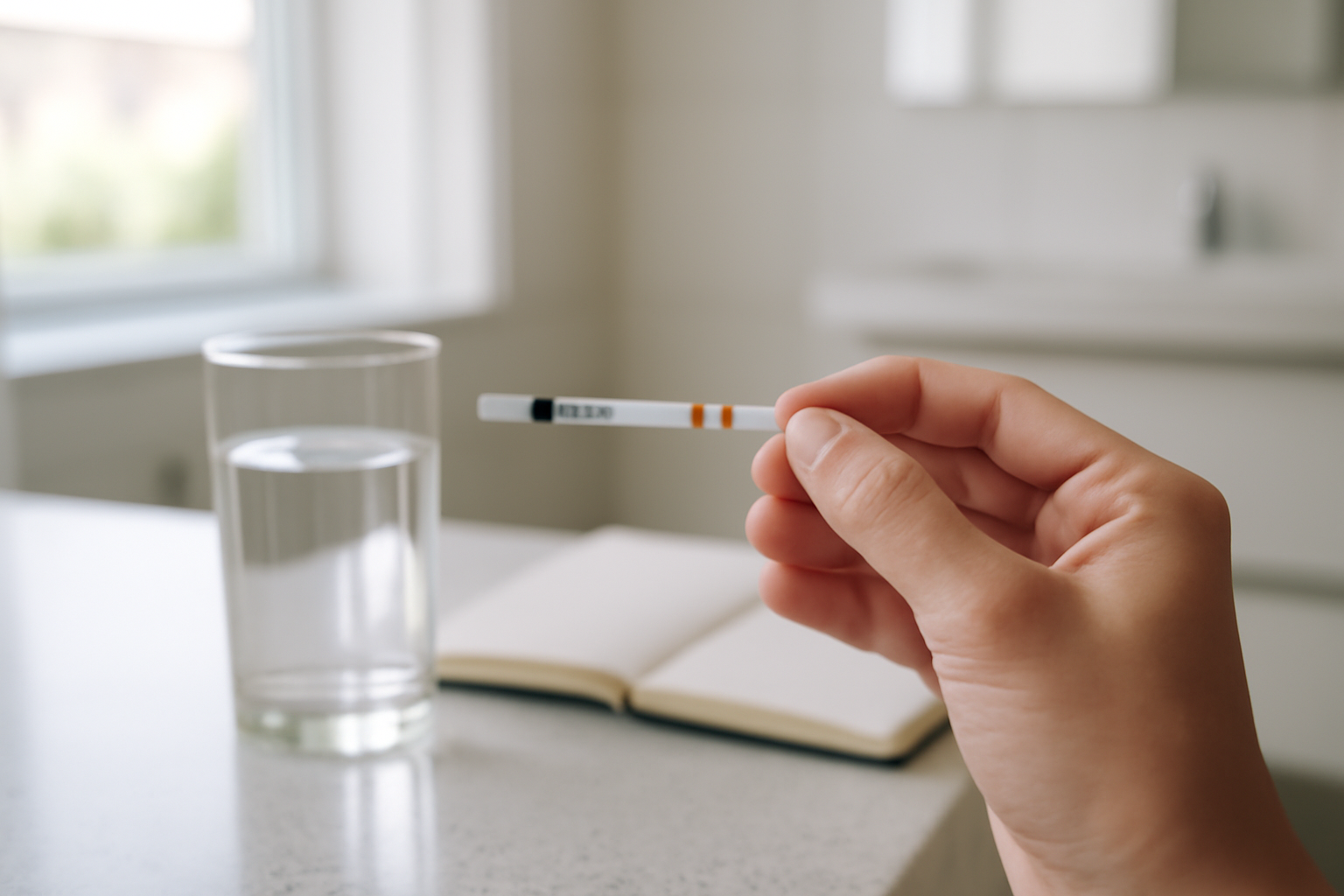
| What a positive OPK means | LH rose above the test threshold (a fertile warning) |
| What it does not prove | That ovulation is happening at that exact moment |
| Typical timing | Ovulation often occurs ~24–36 hours after an LH surge |
| Best sex timing | Day of first positive and the following day |
| How long to test | Often until the surge peaks and begins to fade |
| If pregnancy is possible | Confirm with an hCG test, not more OPKs |
Knowing what does a positive ovulation test mean helps you act quickly. A positive ovulation test (OPK) usually signals an LH surge, which often comes before ovulation. Once you understand what typically happens next, you can time intercourse in the highest-fertility window—without obsessing over every tiny color shift. (And yes, those lines can be stressful.)
How an OPK works: LH surge vs. “ovulation is happening now”
A positive ovulation test means your urine detected a rise in luteinizing hormone (LH) above the test’s threshold. That LH surge often precedes ovulation, but it doesn’t guarantee ovulation is happening at that exact moment. Your cycle and the test’s sensitivity both matter, so treat a positive OPK as a “fertile soon” alert.
OPKs measure LH, not egg release. Ovulation is a whole chain of events—hormone signaling, follicle changes, and the egg’s release—so a strip result is an indirect clue. That’s why two people can both see a “positive” on the same day and still ovulate at slightly different times.
In many timing guides, ovulation happens roughly 24–36 hours after an LH surge begins (with person-to-person variation). Urine concentration also plays a role. If your urine is diluted, you may see your first positive later than you would with more concentrated samples.
What OPKs detect (and what they don’t)
- Detects: LH in urine (a surge above the kit’s cutoff).
- Does not detect: progesterone, the egg, or the exact moment the follicle releases the egg.
- May be influenced by: test sensitivity, timing of sample, and how concentrated your urine is.
If you want a simple rule: once you get a positive OPK, start “fertility-mode” right away. Then keep your plan straightforward enough that you don’t miss the window.
When to expect ovulation after a positive test (timing for intercourse)
After a positive OPK, many people ovulate about 1–2 days later. That’s why the most fertile timing is usually the day of the first positive and the following day. Since sperm can survive several days in the reproductive tract, intercourse before and around ovulation can still lead to pregnancy—even if ovulation lands later than the first positive suggested.
Egg viability is often described as short—commonly around ~24 hours after ovulation. Sperm survival is longer, often several days after sex. So the goal is to have sperm available when the egg becomes available. (It’s less about one perfect minute and more about good timing.)
Here’s a routine that keeps things practical: have intercourse on the day you get the first positive and again the next day. If you can, add one more session on the day before the first positive if your surge seems to be building.
A simple timing routine
- Start testing per the kit instructions (often late morning/afternoon).
- When the first positive appears, have sex that day.
- Have sex again the next day (or every other day during the surge).
- Stop testing once your surge clearly peaks and fades (unless your clinician advised otherwise).
(Quick reality check: LH surges can shift earlier or later depending on your cycle, so this routine aims for high probability—not perfect certainty.)
Interpreting repeated positives: peak, sustained surge, and how many days to test
You might see one positive or several consecutive positives. Repeated positives usually mean your LH level stays above the test threshold for a stretch of time. It doesn’t mean ovulation is delayed forever. A common strategy is to keep testing until you see a clear peak, then stop—because the fertile window is already underway once the surge begins.
Single positives can happen when you catch the surge right as it crosses the cutoff. Multi-day positives can happen when LH stays elevated. Some people even get more than one day of “above threshold” results in the same cycle. Neither pattern automatically signals a problem.
What matters is the peak—often the darkest/strongest strip compared with your control line—followed by the fade. A “sustained surge” is when tests remain positive for more than one day. That can make it hard to know when to stop testing.
How to decide when to stop
- If you get one clear peak day and then lines start getting lighter, you can usually stop.
- If you get consecutive positives without a clear peak, keep testing for a day or two more, then switch to your intercourse plan instead of chasing the strip.
- If you consistently see repeated positives without a later drop and your cycle is irregular, consider discussing your pattern with a clinician.
Over-testing can create anxiety and confusion. Your job is to cover the fertile window—not to interpret every incremental color change like it’s a medical scan.
Why a positive OPK can be confusing in early pregnancy (and what to do)
OPKs are made to detect LH, and early pregnancy can throw a wrench in the process. Pregnancy hormones (especially hCG) may sometimes cross-react on certain tests, or your urine patterns may change. Stress and cycle irregularity can also make timing feel “off.” If you suspect pregnancy, confirm with a pregnancy test (hCG) rather than relying on OPKs.
Pregnancy tests look for hCG, while OPKs target LH. In early pregnancy, hCG can rise quickly. Depending on the test brand and chemistry, some OPKs may produce unexpected lines when hCG is present (this varies by test, so it’s not guaranteed).
If your period is late, a home hCG pregnancy test is usually more useful than continuing OPKs. If you keep getting “positive” OPKs after your expected surge window has passed, that’s a strong cue to change strategies.
What to do next
- Take an hCG pregnancy test if your period is late or you’re within a few days of expected timing.
- If you test very early, repeat in 48 hours if negative and your period still hasn’t come.
- If you get repeated confusing results, ask a clinician about appropriate timing and test selection.
Waiting for clarity can be frustrating. Still, the hCG test is the tool that answers the pregnancy question directly.
Common OPK patterns and what they may mean for fertility timing
Your OPK pattern can help you decide how to time sex. A first positive followed by negatives often suggests a typical surge. A gradual rise to a strong line may mean you’re catching the surge earlier. Very faint positives that never become clearly positive can point to missed timing—or that your cycle hasn’t ramped up yet. If results are consistently unclear, consider adjusting when you test or talking with a clinician.
Watch the trend, not just one strip. Gradual darkening usually means you’re moving toward the peak. A sudden jump to a dark positive can happen if you started testing after the surge began. When the line fades after peaking, that’s usually your cue that the surge window is moving forward.
Testing later in the day can make a difference for some people. LH can peak in the morning or afternoon, so if you test only once per day at the “wrong” time, you might miss the strongest point. Urine dilution matters too—heavy fluids can lower LH concentration and delay when you see a positive.
Pattern-to-action guide
- First positive then negatives: have sex that day and the next day.
- Gradual rise to peak: keep testing, have sex once you hit the first clear positive, then repeat the next day.
- Faint positives that never become clear: test at a consistent time each day and avoid very heavy evening hydration.
- Repeated positives: cover the window by having sex on the first positive day and at least once more during the surge.
If your cycles are irregular, the “right” start day for testing may shift month to month. In that case, a slightly flexible plan (and patience) helps more than rigid expectations. After all, bodies don’t always follow a calendar.
When to seek medical help: irregular cycles, infertility concerns, and next steps
If you’re getting positive OPKs but your cycles are irregular—or you’ve been trying for a while without success—it may be time for personalized guidance. A clinician can assess ovulation, rule out thyroid or hormone issues, and walk through fertility options. Seek earlier care if you have known conditions (like PCOS or endometriosis) or if your cycles are very infrequent.
OPKs can’t confirm ovulation with 100% certainty. A “positive” means LH crossed a threshold, but ovulation timing and confirmation require other methods. Clinicians may add confirmation such as ultrasound monitoring or progesterone testing after the suspected ovulation window.
When to pursue fertility evaluation often depends on age and how long you’ve been trying. Exact cutoffs vary by guideline, but the general idea is simple: the longer you’ve been trying (and the older you are), the more reasonable it becomes to get help sooner. If your cycles are very irregular—long gaps between periods—ovulation timing can be inconsistent even if OPKs sometimes turn positive.
Common next steps a clinician may suggest
- Cycle tracking and ovulation confirmation (ultrasound and/or progesterone).
- Hormone labs (thyroid, prolactin, and other relevant markers depending on your history).
- Evaluation of conditions that affect ovulation (PCOS, endometriosis, and others).
- Fertility planning based on your specific timeline and preferences.
If you want broader context on infertility and fertility guidance, you can review resources like the WHO overview of infertility and the CDC infertility resources. For understanding how fertility timing tools work, the NHS ovulation calculators can also be helpful (even though OPKs add an LH-specific layer).
FAQ
How can I interpret a positive ovulation test if the line is only slightly darker?
A slightly darker test line can mean you’re approaching the LH threshold or that you’re just barely above it, depending on the kit’s cutoff. Use the control line comparison shown on your specific OPK. If it’s not clearly positive by the kit’s rules, keep testing at the same time each day until you see a definite first positive.
What is the best time to have intercourse after a positive ovulation test?
Most people aim for sex on the day of the first positive OPK and the following day. Because sperm can survive several days, intercourse before ovulation can still work. If you can only do one day, choose the first positive day; if you can do two, add the next day for a higher-probability window.
Why do I get positive ovulation tests several days in a row?
Repeated positives usually mean your LH level stayed above the test threshold for more than one day. That can happen in a single cycle as part of a sustained surge. Often, you’ll see a peak (strongest strip) and then fading results. Your fertile window is already active once the surge starts.
When should I take a pregnancy test if I had a positive ovulation test?
Take an hCG pregnancy test when your period is late, or about the day you expect your period (or a few days after). OPKs detect LH, not hCG, so continuing OPK testing after your expected period timing can be confusing. If you test early and it’s negative, repeat in 48 hours if your period still hasn’t arrived.
How long after a positive ovulation test does ovulation usually happen?
Ovulation often occurs about 24–36 hours after an LH surge, which is what the positive OPK reflects. Many people fall roughly into a 1–2 day window after the first positive. Individual timing varies, so plan intercourse for the first positive day and the following day.
Can a positive ovulation test be a false positive early in pregnancy?
Sometimes, yes—depending on the OPK brand and test chemistry. OPKs are designed for LH, but early pregnancy hormones (especially hCG) may cross-react on certain tests, or urine patterns may shift. If pregnancy is possible, confirm with an hCG pregnancy test rather than relying on OPKs.
Key takeaways
- A positive OPK means an LH surge was detected—not that ovulation is happening instantly.
- Most people are most fertile on the day of the first positive and the following day.
- Repeated positives usually reflect an LH surge lasting more than one day; the fertile window is already active.
- If you suspect pregnancy, confirm with an hCG pregnancy test rather than relying on OPKs.
- Adjust testing time and hydration to reduce missed surges or diluted urine results.
- If your cycles are very irregular or you’ve been trying without success, consider medical evaluation for ovulation and fertility factors.
To answer what does a positive ovulation test mean in plain terms: it’s your body’s LH signal that fertility is about to peak. Use it to time intercourse, then let the process unfold—while switching to hCG testing if pregnancy is on the table.
External references
For additional background on infertility and fertility timing resources, see WHO on infertility, CDC infertility overview, and LH (luteinizing hormone) background. For cycle timing support, review NHS ovulation calculators.