
Quick Take: Spotting after ovulation can happen for lots of reasons, including early pregnancy. If it is pregnancy-related, the bleeding is usually light (pink to brown), brief, and not period-like. Timing matters: spotting around the ovulation window tends to be earlier, while implantation-type reports are often about 6–12 days after ovulation. If bleeding is heavy or pain is severe, get medical care.
| Most likely pregnancy-related pattern | Light pink/brown spotting, brief, later than ovulation-window bleeding |
| Typical timing for implantation-type reports | About 6–12 days after ovulation (varies by person) |
| Urine test accuracy window | From the expected period date (often ~14 days after ovulation) |
| If early test is negative | Repeat in 48 hours to reduce false negatives |
| When to seek urgent care | Heavy bleeding, severe pain, dizziness/fainting, fever, foul-smelling discharge |
| Key tracking tools | OPKs, basal body temperature, and a spotting log |
If you are searching for answers like spotting after ovulation pregnant, you are not alone. After ovulation, your hormones shift into the luteal phase, and small changes can show up as light spotting. The tricky part is that early pregnancy can also cause mild bleeding—so timing, color, and amount matter more than any single symptom. (And yes, it can feel stressful to wait.)
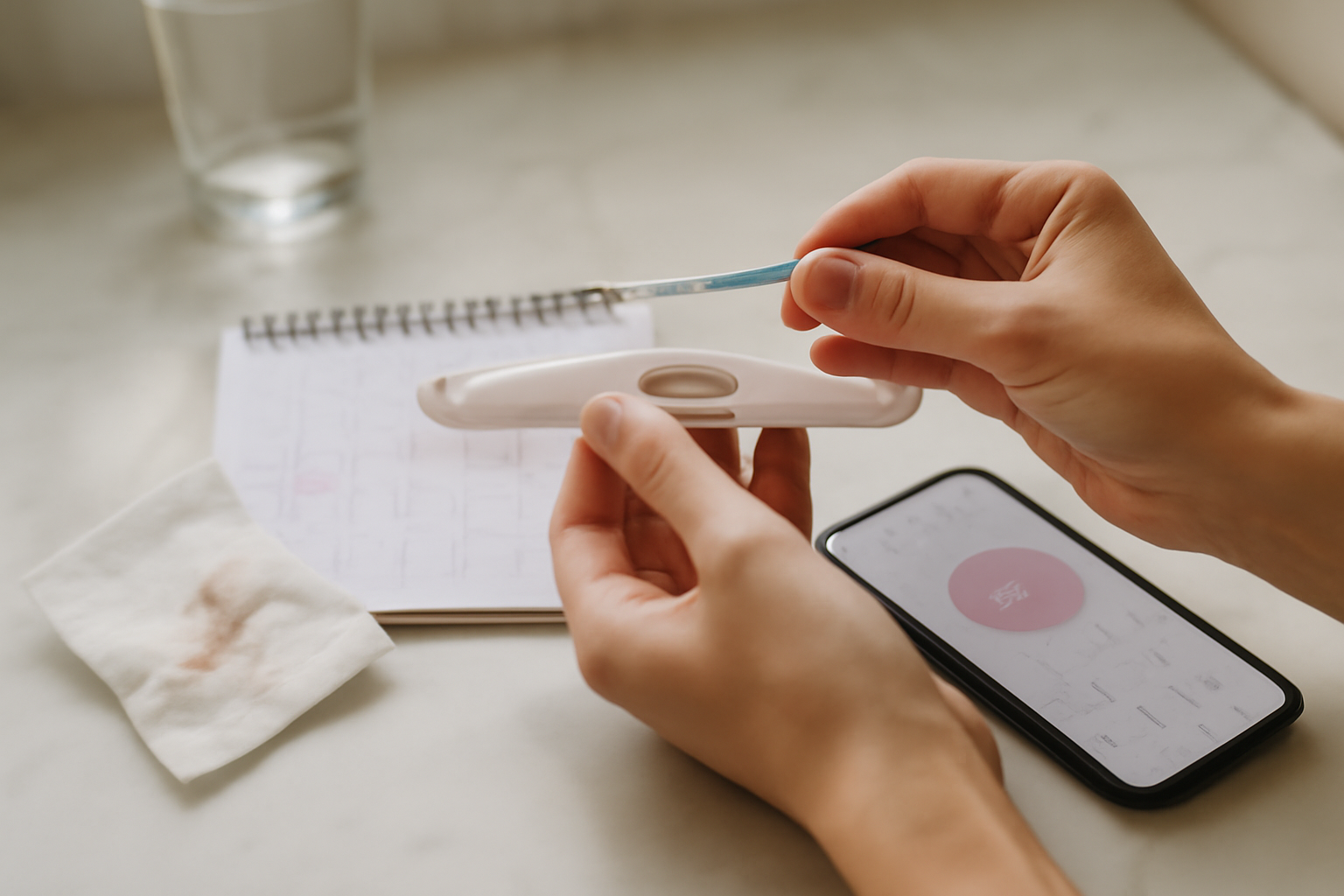
Spotting after ovulation: what « pregnant » bleeding can look like (and what it usually isn’t)
After ovulation, light spotting can happen for several reasons. If pregnancy is possible, bleeding is typically very light (pink to brown), brief, and not like a normal period. Heavy bleeding, worsening cramps, or bright red flow is less consistent with early pregnancy and should be checked promptly.
In a possible early pregnancy, many people describe spotting after ovulation as a few streaks or a small amount on underwear or a liner. Color often looks pink, light brown, or « rusty » rather than bright red. Flow usually stays minimal—more like a « noticeable smear » than a true bleed.
Timing also matters. Implantation bleeding is often reported around 6–12 days after ovulation (it varies from person to person). By contrast, period-like bleeding that ramps up, lasts like a typical period, or arrives as if it is your next period is less likely to be a pregnancy sign.
Spotting alone cannot confirm pregnancy. It can be a clue, but the most reliable confirmation comes from testing—ideally when hCG is rising and detectable.
Ovulation bleeding vs implantation bleeding: timing, color, and cervical signs
Ovulation-related spotting usually shows up around the ovulation window and may last 1–2 days. Implantation bleeding, when it happens, tends to appear later—often about a week after ovulation. It can be pink/brown and lighter than a period. Cervical mucus may shift too: ovulation mucus is often clearer and stretchier, while early pregnancy mucus can feel thicker.
To sort it out, start with timing. Ovulation bleeding is usually tied to the day of ovulation or the day after (and it is commonly short-lived). If you track with OPKs and/or basal body temperature, you might notice spotting right around the fertile window.
Implantation-type bleeding, when people report it, often appears roughly 6–12 days after ovulation. That can land close to (or just before) your expected period date—so it is easy to assume, « My period is coming. » (Cycle length and your ovulation day make a big difference here.)
Next, compare color and flow. Ovulation-window spotting can be light and brief. Implantation-type spotting is frequently described as lighter, more intermittent, and more likely to be pink to brown. Bright red bleeding that becomes heavy is less typical for early pregnancy spotting.
Finally, check cervical signs. Ovulation mucus is often clearer and stretchy (egg-white texture). After ovulation, mucus usually becomes thicker and less stretchy. Some people also notice early pregnancy mucus feels thicker—so mucus alone cannot « diagnose » pregnancy, but it can support your timeline.
Quick comparison checklist
- Ovulation bleeding: around the ovulation window; lasts ~1–2 days; brief and light.
- Implantation-type bleeding: later (often ~6–12 days after ovulation); typically pink/brown; lighter than a period.
- Period-like bleeding: heavier flow, longer duration, and progression like your usual period is less consistent with early pregnancy.
When to take a pregnancy test after ovulation spotting (and how to avoid false negatives)
If spotting happens after ovulation, test timing matters. For most people, a home urine test is more reliable from the day your period is due or about 14 days after ovulation. If you test early and it is negative, repeat in 48 hours. Use first-morning urine and follow the kit instructions.
Because hCG rises over time, an early test can be negative even if pregnancy is present. Many guidance sources point to urine tests being most accurate around a missed period or about 14 days after ovulation. If your ovulation date is uncertain, your expected period date becomes your best reference point.
Test again if you are seeing a negative result early—especially before your period is due. Testing in 48 hours can clarify an early negative because hCG levels typically increase over days.
Practical tips that reduce false negatives:
- Use first-morning urine for the most concentrated sample.
- Check the kit window (read within the stated time; do not interpret later).
- Avoid excessive fluids right before testing.
- If your cycle is irregular, use your ovulation tracking (OPKs/temps) to estimate the earliest reliable test day.
For official consumer-friendly guidance on pregnancy testing and early pregnancy, review resources from CDC pregnancy information and NHS pregnancy guidance.
If you want a more specific timeline for testing after implantation-type bleeding, see How Long After Implantation Bleeding Can I Test?.
Other common causes of post-ovulation spotting (hormones, birth control, infection, and stress)
Spotting after ovulation can also come from hormonal fluctuations (luteal phase changes), starting or stopping hormonal contraception, irregular ovulation, or cervical irritation. Infections or inflammation (including cervicitis) can cause bleeding after sex or unusual discharge. Stress and significant weight changes can affect cycles too—so pregnancy is not the only explanation.
It is easy to fixate on pregnancy when you see spotting, but the luteal phase itself can cause changes. Hormone shifts can lead to light, temporary bleeding. If your ovulation timing changes month to month, your « spotting pattern » may shift as well.
Birth control changes are another common reason. Breakthrough bleeding is a known effect of hormonal contraception, especially during the first months. If you recently started, stopped, or switched methods, cycle changes can continue for several cycles.
Also consider cervical irritation. Sex, pelvic exams, or even tight friction can cause mild bleeding. If you notice bleeding after intercourse along with unusual discharge or pelvic discomfort, look beyond pregnancy.
Possible non-pregnancy causes to keep on your radar
- Hormonal fluctuations: luteal phase changes, irregular ovulation, or temporary hormone imbalance.
- Contraception effects: breakthrough bleeding with pills, patches, rings, implants, or injections.
- Infection/inflammation: cervicitis or other infections can cause bleeding and discharge changes.
- Stress and lifestyle: high stress, intense exercise, or significant weight changes can affect cycles.
If you are concerned about infection risks, ACOG women’s health resources can help you understand when evaluation is appropriate.
If stress might be affecting your cycle, you may also find Can Stress Make Your Period Come Twice a Month? helpful.
Red flags: when spotting after ovulation could mean an urgent problem
Get urgent care if bleeding is heavy (soaking pads), includes severe or one-sided pelvic pain, shoulder pain, dizziness/fainting, fever, or foul-smelling discharge. These can signal conditions like ectopic pregnancy or infection. If you are pregnant or could be pregnant, do not wait—early evaluation can be lifesaving.
Some symptoms should override « wait and see. » If you are soaking a pad quickly, passing large clots, or the bleeding is getting heavier instead of lighter, get medical advice right away.
Severe pain is the biggest concern. Ectopic pregnancy is time-sensitive and can show up with pain and bleeding—sometimes with dizziness, fainting, or pain that feels one-sided. Shoulder pain can also be a warning sign. If pregnancy is possible, these symptoms deserve immediate assessment.
Infection red flags include fever and foul-smelling discharge, especially alongside pelvic pain or bleeding. Infection can worsen without treatment, so prompt evaluation is the safest move.
Call now / go now if you have
- Heavy bleeding (soaking pads), or bleeding that rapidly worsens
- Severe pelvic pain, one-sided pain, or pain with dizziness/fainting
- Shoulder pain
- Fever or chills
- Foul-smelling discharge or significant unusual discharge
If you are unsure, it is reasonable to contact a clinician or your local emergency service. When pregnancy is possible, speed can matter.
How to track and interpret your cycle this month (OPKs, temps, and spotting logs)
To interpret spotting after ovulation, combine a few pieces of information: ovulation timing (OPKs and/or basal body temperature), bleeding pattern (date, color, amount), and symptoms (cramps, breast tenderness, cervical mucus). A spotting log helps you see whether it clusters around ovulation or shows up later. If cycles are irregular or you keep getting unexpected bleeding, consider discussing it with a clinician.
Tracking turns confusion into patterns. Instead of asking, « Is this pregnancy? » try asking, « Where does this fit in my cycle? » First, confirm ovulation if possible. OPKs detect the LH surge, and ovulation often occurs within about 24–36 hours after that surge for many people (not all).
Basal body temperature can confirm ovulation retrospectively. A sustained rise often indicates ovulation happened. Then, you can map spotting to that confirmed timeline. This is especially helpful if you have irregular cycles or you are not sure when ovulation occurred.
Set up a simple spotting log (fast and useful)
- Date: record when spotting starts and stops.
- Color: pink, brown/rust, or bright red.
- Amount: smear, liner only, or pad-level flow.
- Symptoms: cramps, breast tenderness, bloating, fatigue.
- Cervical mucus: note whether it is clear/stretchy or thicker after ovulation.
After 1–2 cycles, look for patterns. Does spotting consistently show up near the ovulation window, or does it appear later (closer to 6–12 days after ovulation)? If unexpected spotting keeps recurring, or your cycles are irregular, bring your log to a clinician—so you are not guessing month after month.
If you are also trying to interpret ovulation test results, read What Does a Positive Ovulation Test Mean for Fertility?.
FAQ
Comment savoir si le spotting après l’ovulation est un signe de grossesse ?
Look at timing, color, and flow. Pregnancy-related spotting is usually light (pink to brown) and brief, often appearing later than ovulation-window spotting (commonly around 6–12 days after ovulation). Spotting alone cannot confirm pregnancy, so test when your period is due or about 14 days after ovulation.
Quel est le bon moment pour faire un test de grossesse après un spotting après ovulation ?
For most people, the most informative home urine test is from the day your period is due or about 14 days after ovulation. If you test early and it’s negative, repeat in 48 hours. Use first-morning urine and follow the kit’s instructions.
Pourquoi ai-je des saignements après l’ovulation mais pas de règles ?
Post-ovulation bleeding can come from hormonal luteal-phase changes, ovulation-related spotting, contraception effects (starting, stopping, or switching methods), cervical irritation, or infection/inflammation. If bleeding is heavy, painful, or persistent, seek medical evaluation.
Quand faut-il s’inquiéter d’un spotting après ovulation pendant une possible grossesse ?
Get urgent care if bleeding is heavy (soaking pads), you have severe or one-sided pelvic pain, dizziness/fainting, fever, foul-smelling discharge, or shoulder pain. These can indicate ectopic pregnancy or infection, which need prompt assessment.
Combien de temps dure généralement l’implantation bleeding vs l’ovulation bleeding ?
Ovulation-related spotting is often short—about 1–2 days. Implantation-type spotting, if it happens, is frequently described as light and brief and typically occurs later, often around 6–12 days after ovulation. Duration varies by person, and some people have no implantation bleeding at all.
Est-ce que c’est possible d’être enceinte même si j’ai des saignements après l’ovulation ?
Yes. Some people experience light spotting in early pregnancy. Still, bleeding can also have non-pregnancy causes, so confirm with a pregnancy test at the right time and seek care for red flags like heavy bleeding or severe pain.
Key takeaways
- Spotting after ovulation is not proof of pregnancy—look at timing, color, and amount.
- Implantation-type spotting (if it happens) is usually light and appears later than ovulation-window bleeding.
- For best accuracy, test around your missed period or about 14 days after ovulation; repeat after 48 hours if negative.
- Heavy bleeding, severe pain, dizziness, fever, or foul discharge are red flags—seek urgent medical care.
- Use OPKs/temperature plus a spotting log to spot patterns and reduce confusion month to month.
- Birth control changes, hormonal shifts, and cervical irritation/infection can all cause post-ovulation spotting.
- If spotting keeps recurring or your cycles are irregular, ask a clinician about evaluation rather than guessing.
When you are dealing with spotting after ovulation pregnant worries, the goal is simple: match the bleeding pattern to your cycle timeline, test at the right time, and do not ignore warning signs. You deserve clarity without guesswork.
Helpful external references: WHO, CDC pregnancy, NHS pregnancy, and ACOG women’s health.
1 commentaire sur « Spotting After Ovulation Pregnant: Causes and What It Means »