
Quick Take
- You can test after implantation bleeding, but the most dependable timing usually starts after a missed period.
- Many people get clearer results about 3–7 days after implantation bleeding (hCG needs time to rise).
- If you test early and it’s negative, retest in about 48 hours—and again after a missed period, especially if the bleeding was light or spotting.
If you’re wondering how long after implantation bleeding can i test, you’re really trying to catch the moment hCG becomes detectable. Implantation bleeding can look like a light period, which makes timing tricky—especially with an irregular cycle or if you’re not sure when implantation happened.
This FAQ-style guide walks you through the practical testing window, what faint lines can mean, and why a negative test sometimes isn’t the final answer. You’ll also find red flags that should be checked urgently, since spotting and cramping can have more than one cause.
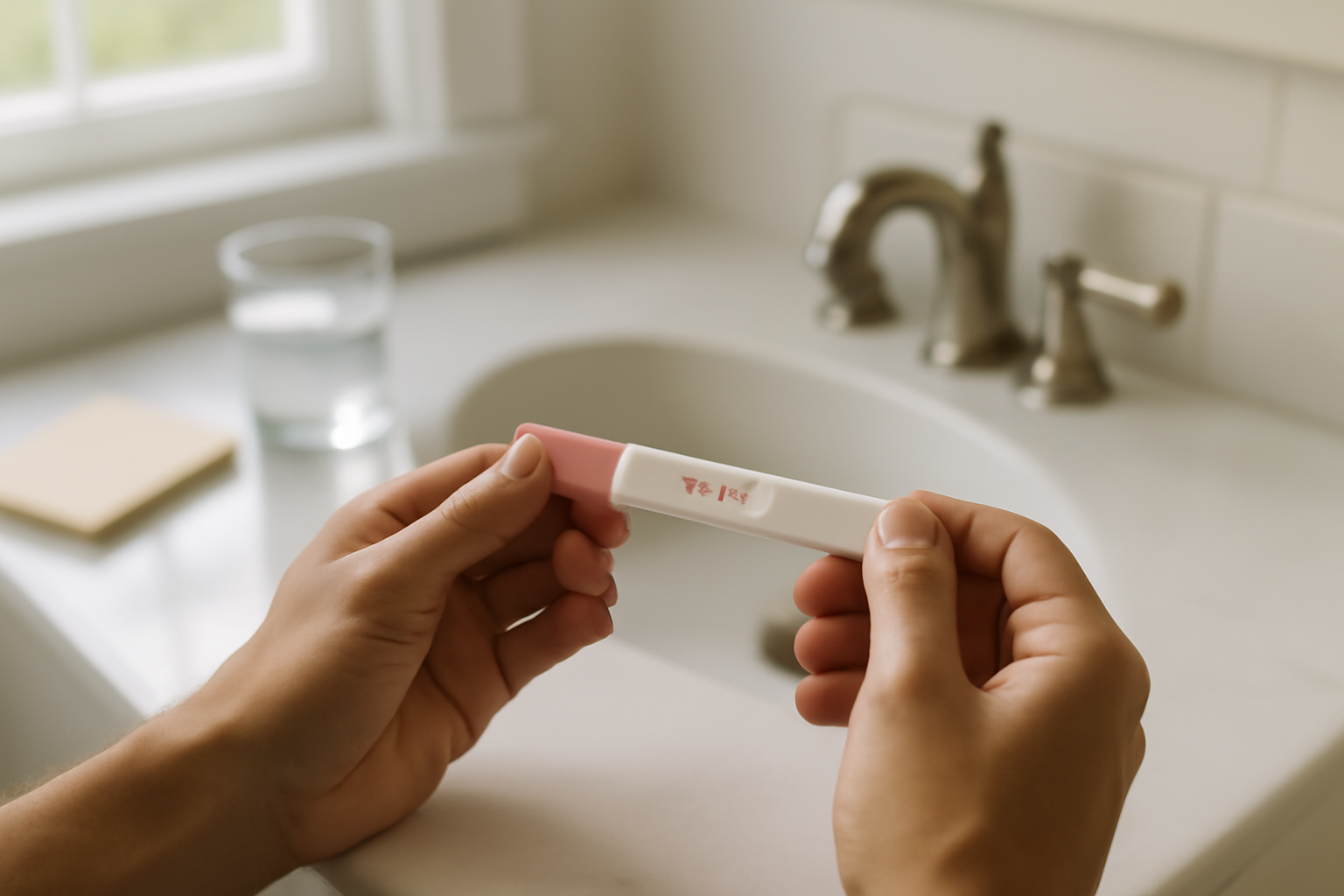
Implantation bleeding vs. a real period: what timing to use for testing
Implantation bleeding often shows up around the time you’d expect your period, but it isn’t the same as a typical menstrual flow. The most reliable anchor for testing is after a missed period, because hCG rises after implantation. If you test while you’re bleeding, results can come back negative even if you are pregnant.
Here’s why the overlap happens: implantation bleeding usually occurs about 10–14 days after ovulation, which is close to when your period would start for many people. That’s why spotting can feel like “my period is here.”
Bleeding alone doesn’t confirm anything. Implantation bleeding can happen in early pregnancy, and the embryo still needs time for hCG to climb. Home urine tests only turn positive once hCG reaches the test’s sensitivity threshold (often around several to 25 mIU/mL, depending on the brand).
So the practical rule is simple: use a missed period as your main reference point. If you want earlier reassurance, you can test during or soon after spotting—but treat a negative result as “possibly too soon,” not as proof you’re not pregnant. (It’s a frustrating waiting game, but it’s also the most accurate one.)
How many days after implantation bleeding to test for the most accurate result
For many people, a home pregnancy test becomes more reliable a few days after implantation bleeding—often around 3 to 7 days later. The reason is straightforward: hCG needs time to rise to detectable levels. Test too early and you may get a false negative. For best accuracy, retest 48 hours later or after a missed period.
hCG generally increases over time after implantation. In early pregnancy, levels can rise fast enough that a test that was negative one day may become positive a couple of days later. That’s why the “wait and retest” approach matters more than chasing one exact day.
Think of it like this: implantation bleeding may happen while hCG is still relatively low. Urine tests need hCG to cross the kit’s detection threshold. Testing 3–7 days after the bleeding gives hCG room to climb.
If your first test is negative but the timing still seems possible, plan a follow-up. Retesting after ~48 hours can catch the natural rise in hCG. It’s often more useful than switching brands immediately (though switching can help if you suspect a low-sensitivity kit).
(Quick reality check: even with good timing, bodies vary. Ovulation timing and implantation timing can shift—so your timeline wins.)
Best test conditions: morning urine, sensitivity (mIU/mL), and how to read faint lines
To get the most accurate result, use first-morning urine and follow the test instructions exactly. Sensitivity is measured in mIU/mL; lower numbers usually detect earlier. A faint line can still be positive if it appears within the time window listed on the kit. If you’re unsure, repeat in 48 hours or try a different brand.
First-morning urine is usually more concentrated because you haven’t diluted it with fluids for hours. That can improve your odds of detecting hCG, especially early on.
Now the sensitivity part: many kits list a sensitivity such as 10–25 mIU/mL (varies by product). In general, a lower mIU/mL threshold can detect smaller amounts of hCG earlier. It doesn’t guarantee a positive result on any specific day, but it can affect how soon you might see one.
Reading faint lines is where many people get stuck. If a line looks faint but is visible within the read-time window on the instructions, treat it as positive. Lines that show up after the time window can be evaporation artifacts.
If you can’t tell whether the line is truly within the window, do two things: check the clock next time (seriously), and retest after 48 hours. With rising hCG, faint positives often become clearer.
What if the test is negative but you had bleeding: when to retest and when to see a clinician
A negative test during or right after implantation bleeding can simply be too early. If bleeding continues or you still haven’t had a period, retest 48 hours later and again after a missed period. Get medical advice urgently if you have severe one-sided pelvic pain, shoulder pain, dizziness/fainting, or heavy bleeding—because causes other than implantation can occur.
Early negative results are common when hCG hasn’t reached the detection threshold yet. Spotting can happen even when implantation occurs, so your test timing needs a little patience.
A retesting schedule that often fits real life: test again after ~48 hours if your first result is negative and you still suspect pregnancy. If you still don’t get a period, test again at that missed-period point. If you’re tracking symptoms or basal body temperature, those can help too—but missed-period timing is still the most dependable home-test window.
Bleeding amount matters as well. Light spotting that fades can fit with implantation, but heavy bleeding (soaking pads quickly) or bleeding that gets worse should be evaluated promptly. If you’re unsure, it’s better to contact a clinician than to wait it out.
Red flags that should not be waited on
Get urgent care if you have severe one-sided pelvic pain, shoulder pain, dizziness or fainting, or very heavy bleeding. These can be warning signs of conditions that need immediate attention, including ectopic pregnancy.
When a blood test (serum hCG) is more helpful than a home test
If you need an earlier or more definitive answer, a clinician can order a quantitative or qualitative serum hCG blood test. Blood tests can detect hCG sooner than urine tests and may be useful when timing is unclear, bleeding is unusual, or home tests keep coming back negative. Ask about repeat blood draws if results are borderline.
Why blood can be earlier: serum hCG is measured directly in the bloodstream, and it often rises before urine tests can reliably detect it. Urine concentration depends on hydration and timing, while blood testing is more controlled.
When it’s especially useful: if your cycle is irregular, if you can’t confidently estimate ovulation/implantation, or if your bleeding doesn’t match your usual period pattern. It’s also helpful if you’ve taken multiple home tests and they’re still negative despite strong pregnancy signs.
Clinicians may repeat testing to confirm the trend. For example, they might order a second hCG draw after a short interval to see whether levels are rising appropriately, rather than relying on a single number.
If you want trustworthy guidance, start with reputable clinical references like the ACOG patient FAQ on pregnancy tests and the NHS guidance on pregnancy testing.
Common misconceptions about implantation bleeding and early pregnancy tests
A common misconception is that any bleeding means you’re not pregnant. Implantation bleeding can happen in early pregnancy, and hCG may still be too low for a urine test at the time spotting occurs. Another misconception is that one test result is definitive; early negatives often need repeat testing. If you’re unsure, use a missed-period test and retest after 48 hours.
Let’s tackle the “bleeding equals not pregnant” idea first. Implantation bleeding varies in timing and amount, so it can be mistaken for a light period. Pregnancy is still possible when spotting happens.
Next misconception: one home test is the final verdict. Early timing can produce false negatives because hCG may not yet be above the kit’s detection threshold. That’s why repeating after 48 hours (and again after a missed period) is more evidence-based than relying on one snapshot.
Finally, people often read faint lines incorrectly. If the line appears within the instructed read-time window, it can indicate a positive result—even if it’s faint. If you’re unsure, repeat with first-morning urine and a sensitivity-appropriate kit.
If you want an overview of reproductive health resources, the CDC reproductive health and infertility resources can help you think through testing and next steps responsibly.
Key takeaways
- Use a missed period as your main anchor: implantation bleeding alone isn’t enough to confirm timing.
- If you test soon after implantation bleeding, expect possible false negatives—wait a few days or retest.
- For many people, testing becomes more reliable about 3–7 days after implantation bleeding, but individual timing varies.
- Use first-morning urine and check the kit’s sensitivity and read-time window for faint lines.
- If negative but bleeding occurred, retest in ~48 hours and again after a missed period.
- Get urgent care for severe one-sided pelvic pain, dizziness/fainting, or heavy bleeding.
- If timing is unclear or home tests disagree, ask a clinician about serum hCG blood testing.
FAQ
How can I tell if it’s implantation bleeding or my period—and when should I test?
Implantation bleeding often happens around 10–14 days after ovulation and can be lighter or shorter than your typical period. Because it overlaps with expected period timing, the most reliable testing anchor is a missed period. If you test during spotting and it’s negative, retest after ~48 hours and again after you miss your period.
What’s the best time to take a pregnancy test after implantation bleeding?
For many people, home tests are more accurate about 3–7 days after implantation bleeding. If you want the best accuracy, wait until after a missed period. Use first-morning urine and follow the read-time window on the kit.
Why can a pregnancy test be negative when I had bleeding?
Bleeding doesn’t rule out pregnancy. If hCG hasn’t risen enough yet, a urine test can be negative even when implantation happened. Early testing, diluted urine, and using a higher-threshold test can all contribute to false negatives.
When should I retest if my result is negative after implantation bleeding?
Retest in about 48 hours if you still suspect pregnancy and your period hasn’t arrived. Then test again after a missed period. If bleeding is heavy or you have concerning symptoms, contact a clinician rather than waiting.
How many days after implantation bleeding should I wait for a reliable result?
A common practical window is 3–7 days after implantation bleeding, because hCG needs time to reach detectable levels. Individual timing varies, so if you test early and get a negative result, repeat after ~48 hours.
Can a urine test be positive with very recent implantation bleeding?
Sometimes, but it’s not guaranteed. If implantation bleeding is very recent, hCG may still be below the kit’s sensitivity threshold. If you test now and it’s negative, treat it as possibly too early and retest after 48 hours or after a missed period.
Sources you can trust for testing basics: WHO pregnancy overview (WHO: pregnancy), NHS pregnancy test guidance (NHS: pregnancy tests), and ACOG patient FAQs (ACOG: pregnancy tests).
If you want to compare timing more precisely, you may also find implantation bleeding: how long before a test? helpful.
And if your cycle timing is confusing, this guide on how many days after ovulation implantation can occur can help you set expectations.
For another common scenario—when bleeding is light—see could i be pregnant if i got my period, but it was light? to understand why results can be misleading early on.
Finally, if you’re trying to rule out other causes of unusual bleeding, reviewing what a blood clot looks like during period may help you describe what you’re seeing to a clinician.