
Most natural ovulation cycles release one mature egg. Two eggs can happen, but it’s uncommon and usually needs more than the usual “one follicle reaches ovulation” pattern.
In most natural cycles, ovulation releases one mature egg (oocyte), not two.
The egg’s survival window is about 12–24 hours, so timing matters.
You can estimate timing at home, but you can’t directly count eggs.
| Typical eggs released per ovulation (natural) | Usually one mature egg; two is uncommon |
| Egg survival after ovulation | About 12–24 hours |
| What age changes most | Ovarian reserve, cycle regularity, and egg quality |
| Home tools that help | Ovulation predictor kits (LH surge), cycle tracking, basal temperature shifts |
| Timing target for conception | Intercourse around the LH surge and the next day |
| When to seek evaluation | Very irregular cycles or delayed conception, especially with age |
One egg per ovulation: what “released” actually means
In a typical cycle, one dominant follicle matures and releases one egg (oocyte) into the fallopian tube. After ovulation, the egg survives about 12–24 hours. Releasing two eggs is rare and usually means more than one follicle reached the ovulatory stage.
“Released” describes the moment ovulation happens—not how many eggs you have stored. Egg availability depends on which follicles start growing and which one(s) finish that cycle’s development. Early on, several follicles may grow, but usually only one crosses the threshold needed to ovulate.
Because the egg’s window is short, timing matters more than the theoretical number of eggs. If sperm is already present when the egg arrives, fertilization can occur; if not, the egg typically won’t last long enough for later conception.
How age changes egg release patterns: regular ovulation vs. ovarian reserve
Age doesn’t usually change the basic “one egg per successful ovulation” pattern. It changes the odds that ovulation happens consistently and the number of follicles that can mature. When ovarian reserve declines, cycles can become less regular and egg quality can drop, even if ovulation still occurs.
It helps to separate two questions: (1) did ovulation happen, and (2) what happened during that ovulation event? Many people still ovulate, but less predictably. If ovulation becomes irregular, you can miss the fertile window even when the “per-ovulation” release pattern is still usually one egg.
Ovarian reserve declines naturally with age. Menopause typically occurs in the early 50s on average (timing varies by population). As reserve decreases, fewer follicles may be recruited, and the body may take longer to reach the hormonal conditions that trigger ovulation—often showing up as longer cycles, shorter cycles, or skipped ovulation. (It’s frustrating, but it’s common.)
What to expect by age: teens, 20s, 30s, and 40s
In the teens and 20s, ovulation is often regular and egg quality tends to be higher. In the 30s, ovulation may still be consistent, but egg quality declines gradually. In the 40s, fewer follicles mature and miscarriage risk rises, so successful conception becomes less likely even when ovulation happens.
For the question “how many eggs are released during ovulation by age naturally,” the practical answer stays the same: most ovulation events still release one mature oocyte. What shifts with age is the likelihood of regular ovulation and the chance that the released egg is chromosomally healthy.
Fertility generally declines with age, and many clinical discussions describe a sharper drop after the mid-30s. Miscarriage risk increases with maternal age across studies and guideline summaries. Individual variation is real—some people in their 30s have very regular cycles and good outcomes, while others in their 20s face challenges.
Egg quality vs. egg number: why “how many” doesn’t tell the whole story
Even with one egg released per ovulation, pregnancy depends on egg quality: DNA integrity, chromosome alignment, and the egg’s ability to support early embryo development. Age affects these factors more than it changes the typical number of eggs released, which is why fertility can fall without any obvious change in “one egg per cycle.”
Egg quality isn’t something you can see at home. It depends on the egg’s developmental stage, the hormonal environment that supports maturation, and the aging process inside the ovary. When egg quality declines, fertilization and/or early embryo development can become less efficient—even if ovulation still occurs.
Clinicians often use markers of ovarian reserve to estimate quantity potential. Tests such as AMH (anti-Müllerian hormone) and the antral follicle count (AFC) help estimate how many follicles are likely to develop, not the egg’s chromosomal or developmental quality. That’s why two people can have similar reserve markers but very different fertility experiences.
What egg quality affects
- Fertilization: the egg must be ready for sperm entry and fusion.
- Embryo development: after fertilization, early divisions must proceed correctly.
- Pregnancy maintenance: chromosomal abnormalities become more common with age and can lead to miscarriage.
When two eggs happen naturally (and how age can influence it)
Two-egg release can happen when more than one follicle matures in the same cycle. Some people are more likely to hyperovulate due to genetic tendency, and hormonal patterns can also play a role. Age can shift cycle dynamics, but two-egg release still stays relatively uncommon without specific triggers.
“Hyperovulation” means multiple eggs are released in the same cycle. Usually, the body’s selection process produces one dominant follicle. For two eggs to be released, more than one follicle has to escape that selection and reach the ovulatory stage.
Natural influences can include a genetic tendency to hyperovulate and hormonal patterns that support multiple follicle maturation. Medical ovulation induction medications are a major reason multiple eggs (and multiples) are more common in fertility treatment settings, but that’s a different scenario than “naturally.” Even in the 30s or 40s, most cycles still follow the single-egg pattern.
Factors that can increase the chance of multiple follicles
- Genetic tendency to hyperovulate (family history of fraternal twins can be a clue).
- Hormonal fluctuation patterns that allow more than one follicle to mature.
- Cycle dynamics where multiple follicles grow toward dominance (still uncommon).
- Ovulation induction medications (not “natural,” but common in fertility treatment settings).
How to estimate your own situation naturally: cycle clues and fertility timing
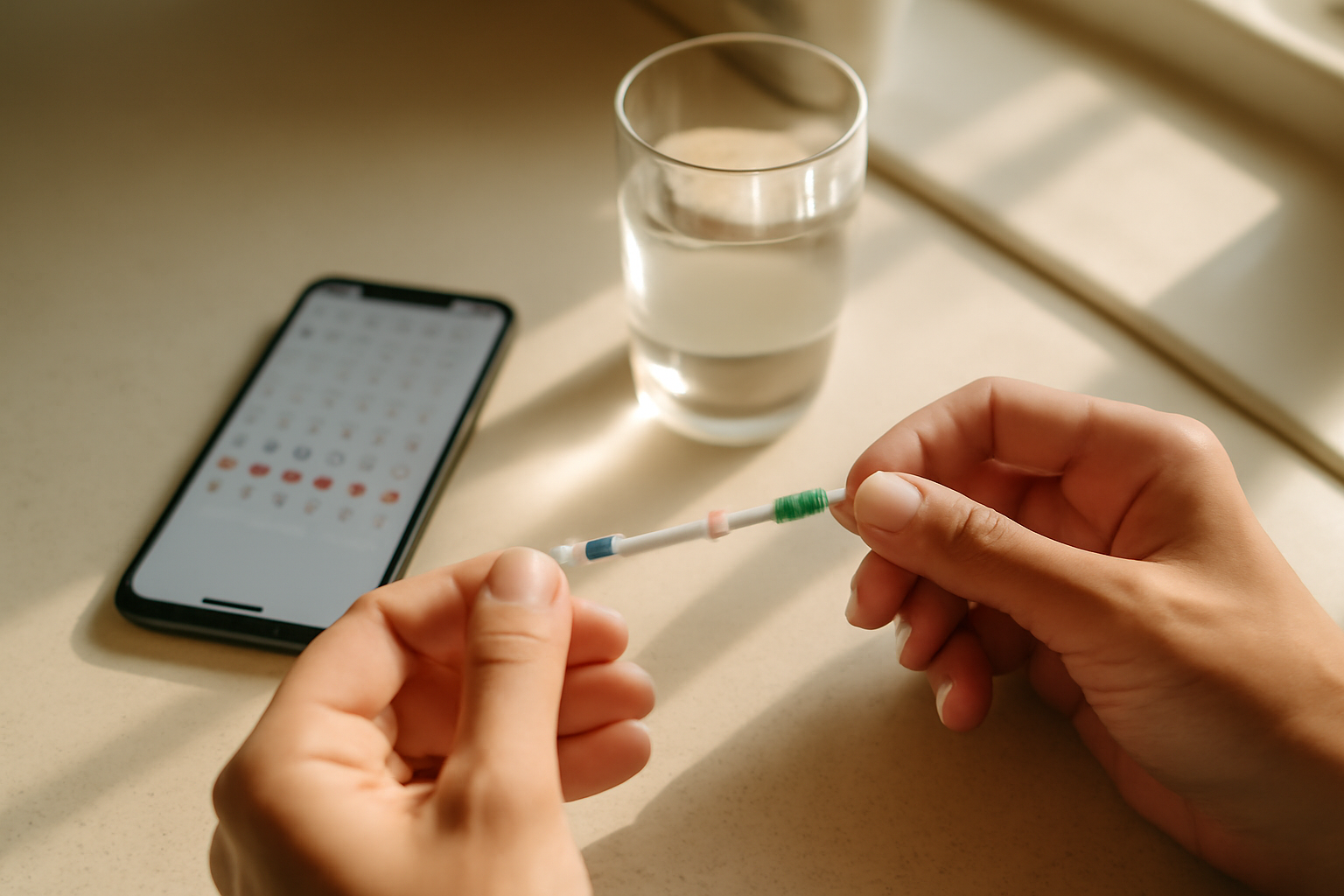
You can’t directly count eggs at home, but you can infer whether ovulation likely happened using cycle regularity, ovulation predictor kits, and basal body temperature shifts. For timing, intercourse around the LH surge and the following day gives sperm the best chance to meet the egg within its 12–24 hour survival window. Why gamble with a short window?
Ovulation predictor kits detect the LH surge. In typical clinical ranges, the surge precedes ovulation by about 24–36 hours. Practically, that means having sperm present before ovulation and keeping it there through the day after.
Basal body temperature (BBT) shifts can confirm ovulation likely occurred because progesterone after ovulation usually raises temperature. One or two “spikes” can be misleading (poor sleep, illness, travel), so look for a sustained shift over multiple days.
Simple at-home timing plan
- Start using ovulation predictor kits a few days before you expect ovulation based on your usual cycle length.
- When you see the LH surge (often the first clearly positive test), have intercourse that day.
- Repeat intercourse the next day to cover the egg’s 12–24 hour survival window.
If you’re trying to conceive and cycles are erratic, don’t wait months to “figure it out” by guessing. Use tracking to guide decisions, then talk with a clinician if you’re not getting results.
When to consider medical evaluation
If cycles are very irregular, ovulation is hard to detect, or pregnancy isn’t happening after a reasonable time, fertility evaluation can clarify what’s going on—especially as age increases. Major public health and professional organizations provide guidance on infertility evaluation.
Learn more from WHO’s infertility overview, the CDC infertility resource page, and ACOG FAQs on infertility.
FAQ
How many eggs are released during ovulation naturally—always one?
Most people release one mature egg per ovulation cycle, and releasing two eggs is uncommon. Two-egg release typically requires multiple follicles to mature in the same cycle, which is not the usual pattern.
How does age affect the number of eggs released per cycle?
Age usually doesn’t change the typical “one egg per successful ovulation” pattern. Instead, it affects ovarian reserve, cycle regularity, and egg quality—so ovulation may be less predictable and fertility can decline even when ovulation still occurs.
Why do I sometimes get two positive ovulation tests in one cycle?
Two positive ovulation tests can happen if LH rises more than once, if the test line stays near-positive for a day, or if the timing of your testing misses the exact peak. It doesn’t automatically mean you released two eggs; it mainly reflects LH hormone patterns.
How can I tell if I actually ovulated or just had hormone fluctuations?
You can’t confirm egg release at home, but you can infer it. Ovulation predictor kits show an LH surge, while basal body temperature shifts and changes in cervical mucus can support that ovulation likely occurred. A sustained temperature rise after the surge is a common clue.
When does ovarian reserve decline start, and what does it change?
Ovarian reserve begins declining naturally with age, though the impact varies widely between individuals. It can change how many follicles mature each cycle, how regular ovulation is, and how likely you are to produce eggs capable of supporting early embryo development.
Is it possible to get pregnant if I have irregular ovulation?
Yes. Irregular ovulation can still produce occasional fertile cycles, and pregnancy is possible. However, it can be harder to time intercourse, and persistent irregularity may signal underlying issues that are worth discussing with a clinician.
Key takeaways
- In most natural cycles, ovulation releases one mature egg; two eggs are uncommon.
- Age usually affects whether ovulation is successful and how many follicles mature, not the basic “one egg per successful ovulation” rule.
- Egg quality declines with age, which can reduce fertility even when ovulation still occurs.
- Home tracking can suggest ovulation timing, but it cannot directly count eggs.
- For conception timing, aim for intercourse around the LH surge and the next day to match the egg’s 12–24 hour window.
- If cycles are very irregular or pregnancy isn’t happening after a reasonable time, consider fertility evaluation—especially as age increases.
For a deeper overview of ovulation biology, see Ovulation (Wikipedia). If you’re weighing fertility questions by age, focus on what changes with age (reserve, regularity, and quality) rather than assuming the “egg count” itself shifts dramatically.
When people ask how many eggs are released during ovulation by age naturally, the most useful answer is still the same: one mature oocyte per ovulation is typical, while age reshapes the odds around it.
2 commentaires sur « How Many Eggs Are Released During Ovulation by Age Naturally »